


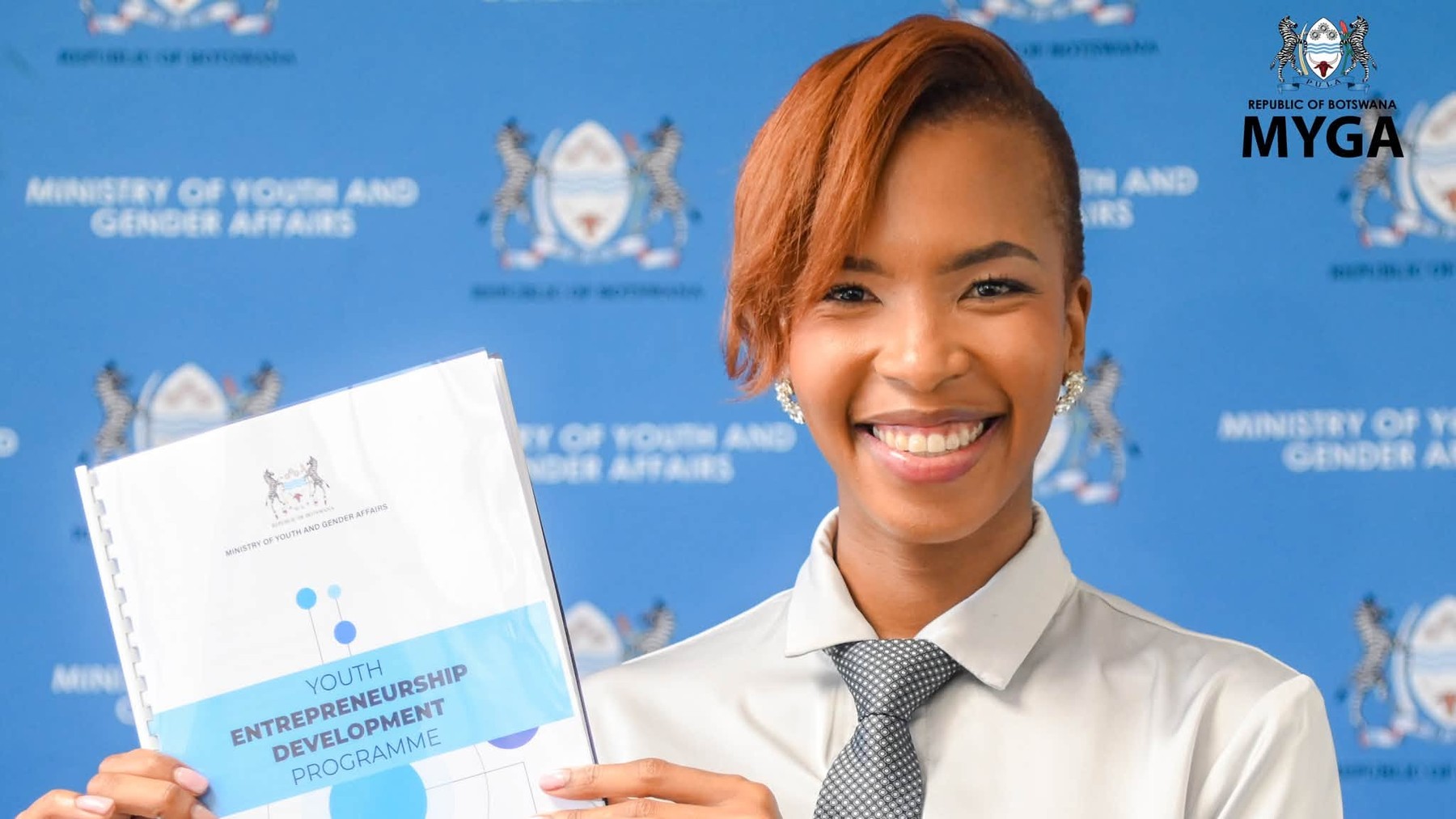
Minister of Youth and Gender Affairs Lesego Chombo holds up the Youth Entrepreneurship Development Programme framework at the ministry's press conference on 13 November. Photo: Ministry of Youth and Gender Affairs
What the official 2026 frameworks say about Botswana's new Youth Entrepreneurship Development Programme, including the six products and what is still unpublished. Applications are not open.
Brimco Insights · 14 November 2026
Cabinet approved a new Youth Entrepreneurship Development Programme on 28 October 2026, and Minister of Youth and Gender Affairs Lesego Chombo launched it on 13 November 2026. Applications are not open. Neither the ministry’s comprehensive framework nor its summarised framework, both dated 2026, gives a start date or a total funding envelope, a point also recorded in Brimco’s news report of the launch on 13 November 2026.
The launch is therefore a framework, not a window for applications. President Duma Boko had told Parliament in the State of the Nation Address on 9 November 2026 that government had completed the evaluation and remodelling of the Youth Development Fund and that the ministry was “now finalizing the operational details of this new programme.” Those operational details, including when young people may apply and how much money is available, have not been published.

The programme does not yet have a final name. The ministry has put six proposed names to a public vote, as reported by Brimco on 13 November 2026. It is aimed at Batswana aged 18 to 35, according to WeekendPost, as cited in that same report.
The framework itself cites a youth unemployment rate of 38.2% in the first quarter of 2024, and says 194,673 young people were unemployed, with secondary-educated youth accounting for 68.7% of that group (ministry summarised framework, 2026). Other official series are not interchangeable with that figure. A ministry-published evaluation by Genesis Analytics, dated 11 May 2026, cites a rate of 28.9% in 2024/25 from Statistics Botswana’s Multi-Topic Household Survey, for ages 15 to 35, and a 2025 World Bank figure of 46% from a modelled International Labour Organization series for ages 15 to 24.
At the centre of the remodel is Youth Entrepreneurship Development Training, lasting up to six weeks. The comprehensive framework (2026) splits it into two tiers: three weeks of practical preparation and assessment, then a further three weeks of mentoring and start-up assistance. Participants who meet the Tier 1 standard may proceed to a financing appraisal without Tier 2 where the relevant product allows it.
The training is to be assessed and accredited by the Botswana Qualifications Authority before it is delivered. Certification is a prerequisite for funding, but it does not guarantee funding. Young people with relevant business qualifications are exempt and may apply for funding directly (comprehensive framework and summarised framework, 2026).
If funding is later approved, the comprehensive framework (2026) provides for a 30- to 40-day post-award programme at temporary Youth Enterprise Support Labs in each district. Those labs are meant to link beneficiaries to institutions including the Local Enterprise Authority, the Botswana Bureau of Standards, the Public Procurement Regulatory Authority, and the Companies and Intellectual Property Authority and the Botswana Unified Revenue Service for registration and tax compliance.
The framework and Brimco’s 13 November 2026 report both note that LEA’s 2026–2029 strategy targets 1,000 competitive enterprises. That is a target, not a funding allocation, and LEA’s own funding capacity is not set out in the YEDP documents.
The new programme replaces the old Youth Development Fund’s single product with six financing options. The instruments are not the same.
Some are grants. Some are public loans. Two are bank loans, with government offering a partial guarantee, on terms set by the lender.
A companion Brimco Insights piece, How the six YEDP products compare, sets out each product in full. The published terms, taken from the comprehensive framework (2026) except where noted, are as follows.
Grants for Remote Area Dwellers are 100% grants of P500 to P20,000 for individuals and up to P100,000 for youth groups and cooperatives. The project must be in a listed remote-area settlement. An annex to the comprehensive framework (2026) names 73 settlements across 17 districts.
Applicants must be Motswana youth aged 18 to 35, hold a training certificate and a business-plan assessment, and be “an impoverished person.” Assets supplied remain government property until the business has run continuously for two years.
Applied Skills Start-Ups are for young people with certified technical and vocational skills. The package is a 50% grant and a 50% interest-free loan of P1,000 to P50,000 for individuals and up to P250,000 for groups and cooperatives, repaid over 21 months after a three-month grace period (comprehensive framework and summarised framework, 2026). The framework says operational costs are not covered, and that equipment remains government property until the loan is settled.
General Start-Up Loans are 100% loans of P50,000 to P250,000 for individuals and up to P1,250,000 for groups and cooperatives. The comprehensive framework (2026) sets repayment over 72 months after a grace period, or 84 months where the grace period exceeds 36 months. The standard length of that grace period is not stated.
The ministry’s summarised framework (2026) describes these loans as interest-free, and Brimco’s 13 November 2026 report follows that wording. The comprehensive framework states clearly that Applied Skills Start-Up loans are interest-free, but it does not restate “interest free” in the Nature of package section for General Start-Ups. That point should be confirmed against the operational rules when they are published.
Applicants must provide business registration documents, tax registration where applicable, and at least two guarantors, and disbursement is to follow verified milestones.
Partial Credit Guarantees for Business Expansion Loans are for youth-owned firms. The summarised framework (2026) and Brimco’s 13 November 2026 report say the firm must have at least three years of viable operation.
The loans themselves are bank loans of P250,000 to P2 million. Government may guarantee up to 70% in year 1, 60% in year 2, 40% in year 3, and none for a mature enterprise (comprehensive framework, 2026, pp. 26–27). The participating financier sets the interest rate, repayment period, grace period and security.
A 70% guarantee is not a grant, and it does not make the loan interest-free.
Industries and Enterprises for Import Substitution are also 100% bank loans with a partial credit guarantee, of P2 million to P50 million per industry (comprehensive framework, 2026). The published documents do not state a 70% cap for this product.
Government is to develop and retain ownership of core productive infrastructure, which qualifying enterprises would access under agreed arrangements. Eligibility in the comprehensive framework (2026) is written for a group of Batswana youth aged 18 to 35, and requires, among other things, that the enterprise has been operational for at least three years, together with audited accounts, tax and business registration, and a value-chain participation agreement. Rollout is to begin with a limited number of viable projects.
The Unicorn Package is reserved for exceptional businesses. The two official documents do not say the same thing about who qualifies, or how the ceiling works.
The summarised framework (2026, p. 7) says the package provides financing above the standard ceiling of any of the Fund’s products, and that eligibility “will be determined by the merits of the business and will not require prior funding or graduation from another product.” The comprehensive framework (2026, p. 34) sets financing of up to P50 million, “subject to and in reference to the applicable standard package ceiling,” and says businesses that meet the minimum operational history requirements under Applied Skills Start-Up, Start-Up General, Business Expansion Loans and the import-substitution package may qualify.
Both wordings are on the official record. Neither should be treated as settled until the operational rules are published.
If these products are offered on the published terms, the range of support is much wider than the old fund’s single ceiling. That is not the same as a promise that any given applicant will receive funding at the top of those ranges.
The Youth Development Fund was established in 2009 (comprehensive framework, 2026; Genesis Analytics, 11 May 2026). It operated as a 50% grant and a 50% interest-free loan, with an individual ceiling of P100,000, a figure given by a ministry official to Daily News on 18 March 2026 and restated in the new framework’s background.
The ministry published Genesis Analytics’ final evaluation, dated 11 May 2026, alongside the new framework. That report is the main public account of the old fund’s scale. Its figures are not internally consistent, and they should be read with their denominators attached, not reduced to a single rate.
Table 7 of the evaluation, drawing on Ministry of Youth and Gender Affairs programme statistics and a YDF statistics extract (Otukile, 2025), records 13,056 beneficiary records from 2009 to April 2025, with total disbursements of P1,262,567,666. The loan component of that long-run series is P631,283,833, and recorded repayments are P21,883,201, or 1.7% of expenditure.
An administrative extract of 5,456 records with documented funding data, covering the 2009/10 to 2019/20 cohorts, shows disbursements of P525,155,181, a loan component of P263,643,832, and recorded repayments of P17,424,640, or 6.6% of the loan component. The report defines that 6.6% recovery rate as loan amounts paid divided by the 50% loan portion. In the April 2025 portfolio cut, 80% of accounts were in arrears of six months or more, and 76% for 12 months or more.
The same report’s executive summary uses looser figures that do not match Table 7 exactly: “over 13,000” beneficiaries, “an estimated 25,000 jobs,” a repayment rate of “4–5%,” and “P1.29 billion disbursed.” A later performance section, citing the most recent Ministry of Youth and Gender Affairs data then available to the evaluators, says 13,170 enterprises have created 26,096 jobs, an average of about two jobs per enterprise, at a historical cost of P49,130 per job. The executive summary’s comparative table uses a different cost of about P66,200 per job. The evaluation states that the quality and durability of those jobs were not assessed.
On a monitoring sample of 1,885 businesses, district officers described about 35% as “operating” or “doing well,” about 2.7% (50 businesses) as having fully repaid, and about 19.5% as collapsed (Genesis Analytics, 11 May 2026). The combined share of collapsed and struggling enterprises is estimated in that chapter at 20–25%. The executive summary separately says about 42.6% of enterprises were ailing or loss-making.
A July 2024 masterlist passage in the same report is internally confused about how many firms were still trading, and it should not be used as a survival rate.
Of the 5,456 documented beneficiaries in the administrative extract, agriculture accounted for 2,830 (52%) and services for 2,060 (38%), with manufacturing at 486 and tourism at 55 (Genesis Analytics, 11 May 2026, Table 7 chapter). The evaluation says annual allocations historically rose from about P60 million to P120 million, with “recent downward pressure due to fiscal constraints.”
The old fund did put capital into youth businesses. On the published figures, it did not revolve as a 50% loan book is supposed to revolve. That record is the reason the remodel exists, and it is also a reason not to treat public youth finance as a grant in all but name.
The new programme does not replace the Citizen Entrepreneurial Development Agency or the Local Enterprise Authority. They are distinct institutions, and they should be read as such.
CEDA’s own website, accessed on 14 November 2026, states loan products of up to P1 million for small businesses, P10 million for medium enterprises and P50 million for large-scale ventures. Its credit-guarantee scheme, on the same site, covers 75% of net loss on facilities from P10,000 to P4 million, at a 1.5% annual guarantee fee. Those products are not youth-only.
Daily News, on 13 April 2026, reported a parliamentary reply by Assistant Minister of Trade and Entrepreneurship Baratiwa Mathoothe. As at the end of December 2025, the third quarter of the 2025/26 financial year, CEDA had invested P696 million in 1,716 businesses, created 3,109 new jobs and safeguarded 1,569 existing ones, and recovered P814 million.
The same reply put CEDA’s prime lending rate at 10.76%, with a three-percentage-point subsidy in named priority sectors. No published YEDP envelope exists against which those figures could be fairly ratioed.
LEA appears in the new design mainly as a business-development partner, through the district labs and the 1,000-enterprise target in its 2026–2029 strategy (comprehensive framework, 2026; Brimco, 13 November 2026). Whether CEDA has a separate youth-only window, and what budget LEA has to support YEDP beneficiaries, are not established in the documents reviewed for this analysis.
Vice President and Minister of Finance Ndaba Gaolathe told a Youth Budget Pitso in late October 2026 that remodelling the Youth Development Fund, alongside a National Fund of Funds, would expand financing for young people, and that government should act as a catalyst rather than the main financier of investment (Daily News, as cited by Brimco on 13 November 2026). The new guarantee products are closer to that catalyst model than a pure grant-and-loan fund. They are also a contingent public liability.
The comprehensive framework (2026) says government’s exposure will be managed through defined guarantee limits, a funded reserve, and claim procedures agreed with the Ministry of Finance. Those limits and the size of the reserve have not been published.
If the products are implemented as published, the first constraint is time, not a form. Training can take up to six weeks, and a certificate does not decide the funding outcome.
Several products require a registered business, proof of a site, recent quotations, or three years of viable operation. General Start-Up Loans require at least two guarantors.
Expansion and import-substitution finance, if offered on the published terms, would be priced by lenders, not offered as a public interest-free loan. A young person comparing those options with CEDA should not assume that a YEDP guarantee is cheaper, or easier to obtain, than CEDA’s own products. The lenders have not been named, and the interest-free status of general start-up loans is not settled between the two official YEDP documents.
Assets bought with Applied Skills support, and with general start-up loans, may be ceded to government until the loan is settled. Assets supplied under Remote Area Dweller grants remain government property for two years of continuous operation (comprehensive framework, 2026). A 70% guarantee on an expansion loan still leaves the borrower on a commercial facility, and the published coverage is designed to fall over time.
The Unicorn Package and the import-substitution rules are incomplete in the sense that matters to an applicant: the official documents disagree on Unicorn eligibility, and neither package can be used until participating financiers, project sites and operational manuals exist.
No application opening or closing date has been published, and the old Youth Development Fund’s May–June calendar, still described on the government’s YDF service page, should not be treated as the calendar for the new programme.
No total funding envelope, and no 2026/27 allocation for the new programme, has been published. The professional fund manager has not been named, and no participating banks or other financiers have been listed. It is not yet public how, or whether, the old fund’s loan book will be separated from new money.
The final programme name is still subject to a public vote. The standard grace period for general start-up loans is not stated.
The interest-free status of those loans, and the eligibility rules for the Unicorn Package, are points on which the official documents conflict. Government’s aggregate guarantee limit and the size of the reserve to be agreed with the Ministry of Finance are unpublished.
Differentiated products and mandatory preparation are a rational response to a fund that, on the published evaluation, recovered only a small share of its loan book. The approved framework addresses weaknesses that the 11 May 2026 evaluation documented: a single product, weak aftercare, and limited private capital.
Whether repayment, enterprise survival and private lending actually improve is a separate question. The framework itself promises an independent evaluation after three years.
Until there is a published envelope, a start date and named lenders, the programme cannot be judged on delivery. It can only be read as a design.
Applications are not open, but several of the published products already assume a legally registered enterprise, and the post-award labs are designed to involve the Companies and Intellectual Property Authority and the Botswana Unified Revenue Service. The step that does not depend on a start date is to register, or regularise, the business.
Start with Brimco’s Start a Business series, including 7 Steps to Starting a Business in Botswana and How to Incorporate a Business in Botswana. The launch report remains Botswana Replaces Youth Development Fund With Six-Product Programme.

Written by
Tumisang Bogwasi, Founder & CEO of Brimco. 2X Award-Winning Entrepreneur. It all started with a popsicle stand.
November 14, 2026
How the six YEDP products compareThe six YEDP financing products compared from the 2026 official frameworks, including amounts, conditions and the points on
October 28, 2026
How to Value a Small Business in Botswana: Three Valuation Methods


