


The 10 November accord, signed in Paris a day after Botswana said it would double its De Beers stake, backs natural-diamond terminology, sourcing standards and annual reporting from 2027.
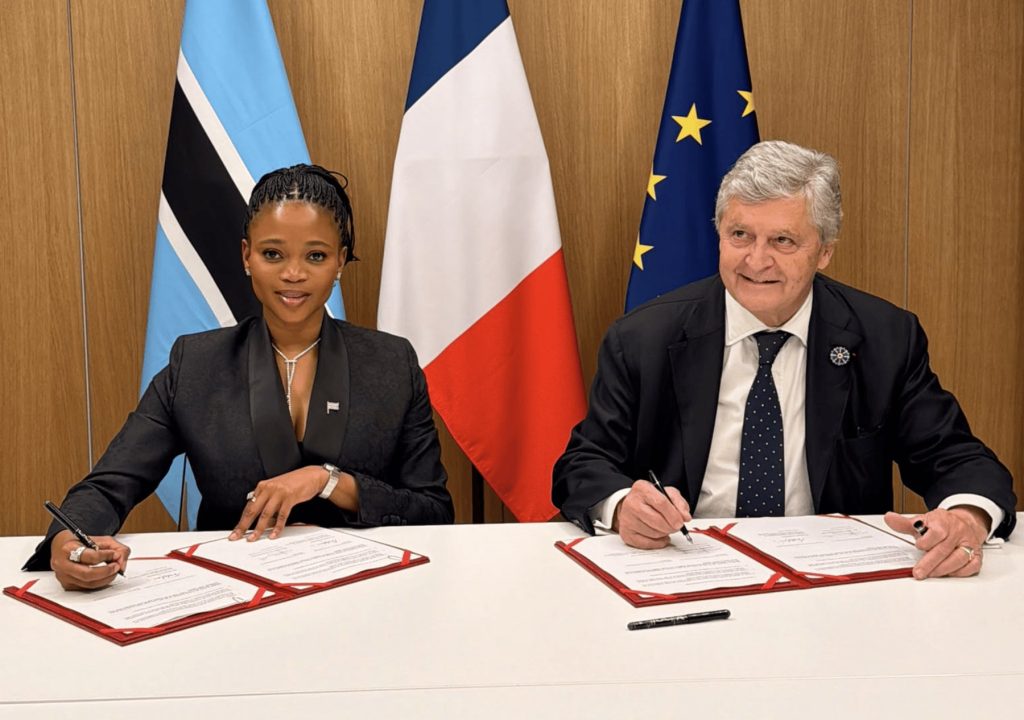
PARIS – Botswana and France signed the Paris Declaration on Natural Diamonds on 10 November, committing to treat the word “diamond” as referring to a natural stone and to promote responsible growth in the sector. The signing took place at the Paris Peace Forum, held at the Musée de la Marine, Women’s Wear Daily reported.

France was represented by Nicolas Forissier, minister delegate for foreign trade and economic attractiveness. Botswana was represented by Bogolo Joy Kenewendo, minister of minerals and energy, a title also used by the government’s Daily News. The ceremony coincides with the 60th anniversary of Botswana’s independence and of diplomatic relations between the two countries, WWD said.
The declaration recognises the contribution of natural diamonds to producer economies. It calls for responsible, transparent sourcing, worker protections, and clear terminology, “specifying that ‘diamond’ refers to a natural diamond,” WWD reported.
JCK, citing a statement on the text, said the two governments agreed on “the need for clear, accurate, and consistent terminology” with diamond “referring specifically to a natural diamond,” language it said was aimed at strengthening consumer trust and protecting the “integrity of natural diamonds.” JCK also said the sourcing language is supported through the Kimberley Process and refers to workers’ rights, working conditions, health and safety, and respect for local communities.
The two countries intend to set up a joint working group with private-sector representatives to monitor implementation and publish annual progress reports starting in 2027. The declaration also calls for public information initiatives and the application of existing consumer-protection laws, rather than a new legal regime.
The terminology fight is the point. Laboratory-grown stones have undercut prices and demand for mined diamonds, a pressure already visible in Anglo American’s plan to exit De Beers. For Botswana, whose fiscal base still runs through Debswana and the state’s rough-sales arm, Okavango Diamond Company, a weaker natural-diamond market is a revenue risk, as Brimco reported after President Duma Boko’s State of the Nation Address.
Boko previewed the Paris signing in that 9 November speech. “We’ve argued that they must not be called diamonds,” he said of synthetic stones, according to JCK. “I’m happy to indicate that we will be signing an agreement in Paris; our minister will go, where France now has come on board with us, to defend our proposition that diamonds be reserved only for the natural diamond.”
A day before the signing, Boko said Botswana would double its De Beers stake from 15% to 30% as a Gareth Penny-led consortium pursues Anglo American’s majority holding, with Namibia and Angola also expected to take part. Binding documents are not yet final.
Amber Pepper, chief executive of The Diamond Collective, formerly the Natural Diamond Council, welcomed the declaration. “It is a reminder that the value of a natural diamond extends far beyond its beauty, supporting livelihoods, communities and economies in producing countries around the world,” she said. The group said natural diamonds contributed 25% of Botswana’s GDP and 80% of exports in 2023, figures that describe a recent year, not a forecast.
The declaration names no penalties. Its weight will depend on whether the reports, campaigns and consumer-protection rules change how stones are described in the market.

Written by
Tumisang Bogwasi, Founder & CEO of Brimco. 2X Award-Winning Entrepreneur. It all started with a popsicle stand.


