NASA's Juno spacecraft is providing new insights into the extreme volcanic activity of Jupiter's moon Io, mapping previously hidden heat sources. The ongoing mission utilizes advanced instruments to study Io's internal structure and the intense tidal forces from Jupiter that fuel its volcanism, offering crucial data for understanding planetary geological processes.
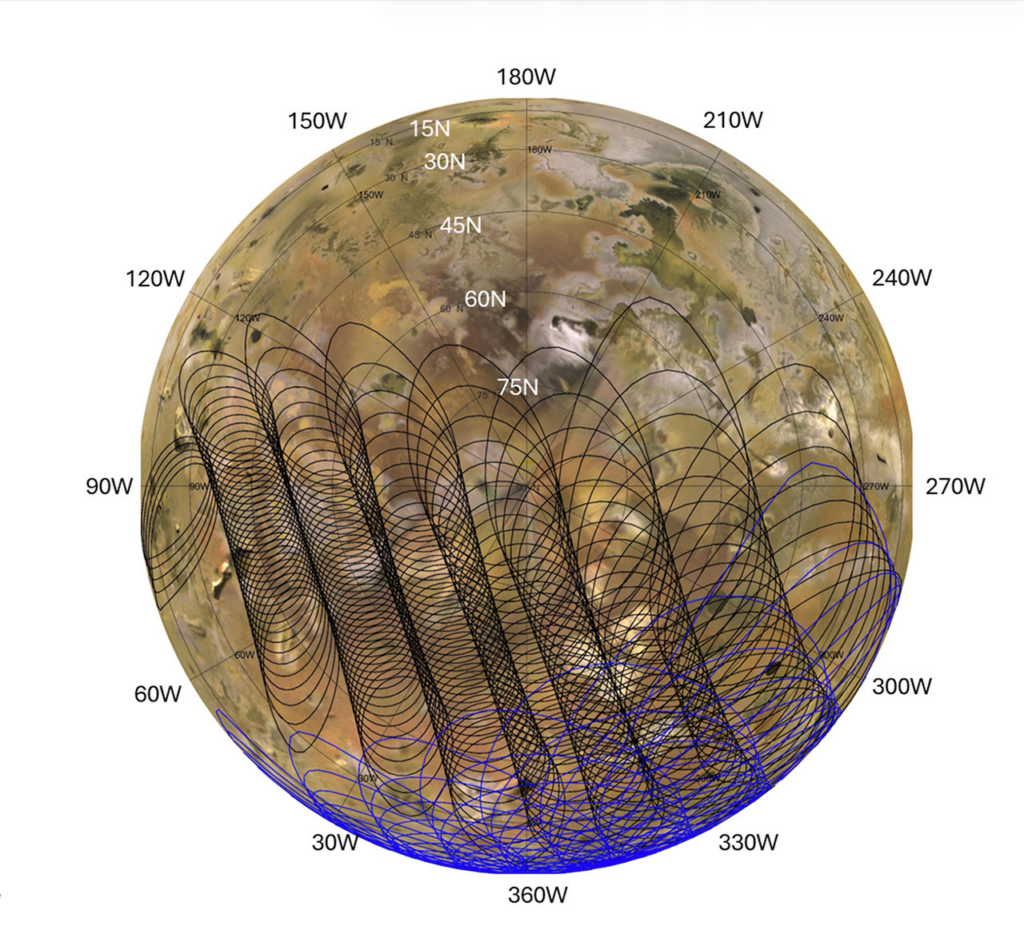
PASADENA, United States – NASA‘s Juno spacecraft has begun revealing previously undetected heat signatures on Io, Jupiter’s most volcanically active moon. The mission aims to map the moon’s internal heat distribution, driven by intense tidal forces from Jupiter, according to a recent report by NASA Science. This investigation provides critical data for understanding the dynamics of extreme volcanism in the solar system.

Io is renowned as the most volcanically active body in the solar system, a characteristic primarily attributed to the immense gravitational pull exerted by Jupiter. This constant gravitational stress generates significant internal friction, heating Io’s interior and causing widespread volcanism on its surface, as detailed by NASA’s Jet Propulsion Laboratory.
The Juno spacecraft, which has been orbiting Jupiter since 2016, has conducted multiple close flybys of Io. These maneuvers allow its suite of instruments to collect high-resolution data on the moon’s thermal emissions and surface features. By studying these heat patterns, scientists can infer the distribution of magma chambers and the efficiency of tidal heating within Io’s mantle.
The findings from NASA’s Juno mission hold significant implications for the global aerospace and space exploration industries. Enhanced understanding of planetary geology and extreme environments can inform the design of future spacecraft and instruments targeting similarly challenging celestial bodies.
Investment in deep space missions, particularly those focused on planetary science, continues to drive technological innovation. This includes advancements in remote sensing, thermal imaging, and data analysis, which have broad applications beyond space exploration, potentially impacting fields such as terrestrial geothermal energy assessment and materials science. The mission also reinforces international scientific collaboration and competitiveness in the burgeoning space economy.
Understanding Io’s volcanic mechanisms contributes to the broader scientific goal of characterizing habitable zones and the potential for life beyond Earth. While Io’s surface is hostile due to intense radiation and volcanism, studying its energy dynamics offers parallels to early Earth and other potentially geologically active exoplanets. The insights gained refine models of planetary evolution, impacting research trajectories for institutions and private aerospace firms globally.
The Juno mission’s primary objective is to study Jupiter’s origin and evolution. Its extended mission phase includes close encounters with Io, enabling detailed observations that were not part of its initial mandate. These additional observations provide a rare opportunity to characterize a world shaped by continuous, powerful geological forces, contributing to a more complete picture of the Jovian system and planetary science at large, according to NASA’s mission overview.

Written by
Tumisang Bogwasi, Founder & CEO of Brimco. 2X Award-Winning Entrepreneur. It all started with a popsicle stand.