NASA's Chandra X-ray Observatory has determined the source of high-frequency treble clef waves in the Perseus cluster, tracing the pressure oscillations to energetic feedback from a central supermassive black hole.
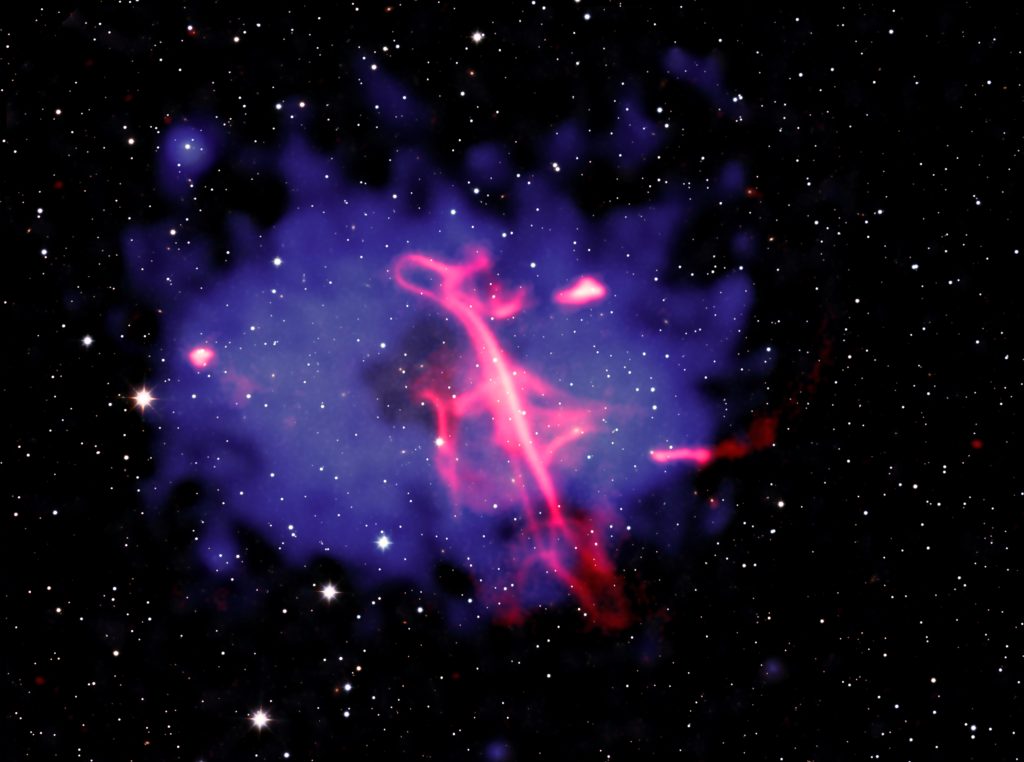
Washington, United States: The Chandra X-ray Observatory identified the origin of high-frequency oscillations termed treble clef waves inside the Perseus galaxy cluster. These cosmic pressure waves propagate through superheated plasma, delivering operational data on how black holes regulate surrounding environments.

The detection provides empirical validation for astrophysical energy models and space science research programs. By tracing wave generation directly to black hole activity, researchers secure critical baselines to evaluate galactic thermal regulation and optimize resource planning for upcoming orbital telescopes.
The treble clef ripples represent pressure oscillations traveling through plasma heated to tens of millions of degrees across the cluster. The central supermassive black hole generates these acoustic disturbances during active feeding cycles, confirmed in the NASA mission update.
As infalling matter fuels relativistic jets, the resulting shock front expels energy into the surrounding intergalactic gas. This continuous displacement produces high-frequency waves whose pitch and velocity correspond to black hole power output, allowing researchers to quantify mechanical energy injections.
The discovery resolves longstanding theoretical uncertainties surrounding galaxy evolution and intergalactic thermodynamics. The identified feedback loop demonstrates that black hole outbursts actively prevent surrounding gas reservoirs from cooling and collapsing into premature star clusters.
Orbital research programs coordinated via the Chandra X-ray Center use these physical parameters to refine computational models of cosmic matter distribution. Better modeling capabilities enhance technical roadmaps for next-generation space exploration payloads targeting high-energy radiation regimes.
Scientists plan targeted Chandra observation campaigns to track subtle gas temperature shifts across the Perseus system. High-resolution X-ray spectrometers capture minute thermal variations that remain undetected by standard optical or radio instruments.
Continued acoustic mapping establishes a quantitative benchmark for intergalactic heating across billions of light-years. These empirical datasets guide capital investment decisions for deep-space observatory hardware and ongoing international astrophysical survey initiatives.

Written by
Tumisang Bogwasi, Founder & CEO of Brimco. 2X Award-Winning Entrepreneur. It all started with a popsicle stand.