In 1997, Hong Kong returned to Chinese sovereignty after 156 years of British colonial rule, initiating the 'one country, two systems' framework. This historic transition established Hong Kong as a Special Administrative Region, maintaining its capitalist economy and distinct legal system while integrating with mainland China.
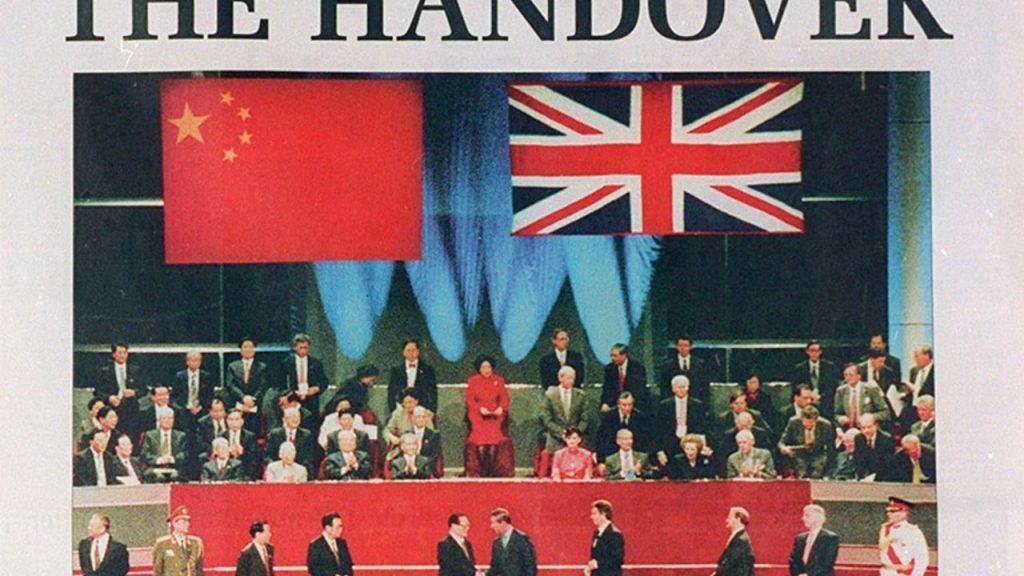
HONG KONG, China – Hong Kong officially transitioned to Chinese sovereignty at midnight on July 1, 1997, concluding 156 years of British colonial administration. This momentous event marked the implementation of the “one country, two systems” principle, designed to preserve Hong Kong’s distinct economic and legal frameworks for 50 years. The ceremony at the Convention and Exhibition Centre witnessed the lowering of the British and Hong Kong flags and the raising of China’s national flag and the Hong Kong Special Administrative Region flag, according to a South China Morning Post archive.
The handover inaugurated Tung Chee-hwa as Hong Kong’s first Chief Executive, succeeding British Governor Chris Patten. Chinese President Jiang Zemin pledged non-interference in Hong Kong’s internal affairs, underscoring the unique governance model. This arrangement allowed Hong Kong to retain its capitalist system, independent judiciary, and currency, the Hong Kong dollar, distinct from mainland China’s yuan, as detailed by The National Archives.

The “one country, two systems” principle represented a novel approach to reunification, designed by Deng Xiaoping. It legally enshrined Hong Kong’s autonomy in all areas except defense and foreign affairs. This framework was critical for maintaining investor confidence and Hong Kong’s status as a global financial hub.
The continuity of its common law legal system and free-market economy was a central promise of the handover agreement, known as the Sino-British Joint Declaration. This unique governance model facilitated Hong Kong’s role as a primary gateway for foreign direct investment into mainland China and a key offshore financial center for Chinese enterprises.
The city’s stock exchange remained a crucial platform for international capital, distinct from mainland exchanges regulated by the China Securities Regulatory Commission. The People’s Bank of China (PBOC) continued to oversee the mainland’s monetary policy, while the Hong Kong Monetary Authority managed its own financial stability.
Following the handover, Hong Kong’s economy experienced a gradual integration with mainland China. This process involved increased trade, cross-border investments, and tourism, strengthening economic ties. Hong Kong maintained its pegged exchange rate to the U.S. dollar, providing a stable financial environment amidst regional economic shifts.
This stability contrasted with the mainland’s managed floating exchange rate for the yuan (renminbi). The Belt and Road Initiative (BRI) later leveraged Hong Kong’s financial and legal expertise as a platform for project financing and dispute resolution. Hong Kong’s role as an international financial center has evolved, balancing its unique autonomy with its increasing economic interdependence with the mainland, as noted by Reuters’ historical reporting.
BEIJING, China – The 1997 handover of Hong Kong significantly impacted China’s economic and political landscape. For Beijing, the return represented a key step in its national reunification goals and a demonstration of its growing global influence. The “one country, two systems” model was intended to serve as a precedent for future territorial integrations, such as with Taiwan.
Economically, Hong Kong’s status as a leading financial market and a major port bolstered China’s access to international capital and trade routes. It facilitated the internationalization of Chinese businesses and provided a sophisticated financial infrastructure that complemented mainland development. The arrangement allowed Beijing to benefit from Hong Kong’s global connections without fully integrating its distinct capitalist system into the socialist market economy of the mainland.
The handover also presented challenges, particularly in managing the balance between Hong Kong’s autonomy and China’s sovereignty. The interaction between Hong Kong’s common law system and mainland China’s civil law system required careful navigation. Beijing’s long-term strategy involved leveraging Hong Kong’s economic prowess while gradually increasing its influence, impacting areas such as electoral reform and national security legislation in the decades following the 1997 transition.

Written by
Tumisang Bogwasi, Founder & CEO of Brimco. 2X Award-Winning Entrepreneur. It all started with a popsicle stand.