South Africa's president said the impact of strained relations is being managed, and that he has not spoken to Trump since their May 2025 meeting. AGOA access is due to end on 1 January 2027.
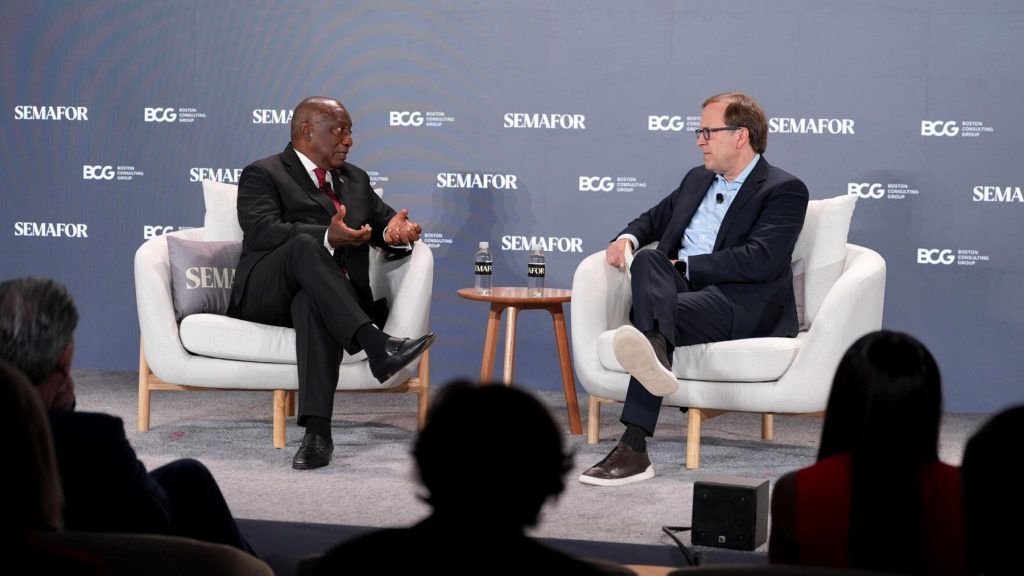
SAN JOSE, United States – South African President Cyril Ramaphosa said on 16 November that the breakdown in relations with Washington has hurt South Africa, but that the United States remains too important a market for South African exporters to give up on.

Speaking at Semafor’s Silicon Valley & The World summit in California, Ramaphosa also said he had not spoken to US President Donald Trump since their Oval Office meeting in May 2025, though he had left a message to tell him about the visit.
Asked by ABC News chief Washington correspondent Jonathan Karl how much the rupture had hurt South Africa, Ramaphosa said: “It’s an impact that we are managing and we’ve always said that relations between South Africa and the US are very important.”
“The US remains the largest economy in the world and there are a number of our businesses that export commodities and products to the United States,” he said. He said South Africa wanted relations based on mutual respect and on dealing with each other “fairly and transparently”, with a way to resolve problems when they arise.
Ramaphosa said he had placed a call to Trump before the trip. “I think he was just too busy to respond, but he often takes my calls and so I’m sure he will return my call,” he said. Asked whether the two had spoken since the Oval Office meeting, he said: “No, we haven’t spoken since that meeting.”
He described that meeting as “an ambush” and said Trump had been “seriously misinformed”. He said the misinformation “has tended to underpin the way the US has related to us in South Africa”, and that South Africa had tried to correct it while dealing with “the reality of where our country is and where we want to go in cooperation with the United States”.
Ramaphosa declined to comment on the 3 November US midterm elections, saying South Africa does not interfere in other countries’ politics.
US Trade Representative Jamieson Greer has confirmed that Trump notified Congress of plans to end South Africa’s eligibility for the African Growth and Opportunity Act (AGOA) from 1 January 2027, Brimco reported earlier this month. South African exports using AGOA preferences fell to $1.7 billion in 2025 from $4 billion in 2024, and most shipments already enter the US under standard World Trade Organization terms. Sectors that still rely on the preferences, such as citrus and some automotive and agricultural products, face standard tariffs once access ends.
Semafor reported that Washington has also pulled PEPFAR health funding and imposed visa restrictions on some South African officials. It said US Ambassador L. Brent Bozell III has warned that black economic empowerment ownership rules are holding back “billions with a B” in US capital. Semafor also reported that the value of trade between the two countries rose in 2025, and that companies such as Alcoa and Wabtec have continued to invest.
For exporters, the message from Pretoria is that it will keep engaging with Washington while trying to win investment directly from US companies. Ramaphosa said the delegation wanted to add to the 600 US companies already operating in South Africa. There was no sign in the interview of a change in the policies Washington objects to. Businesses with US exposure should plan for the AGOA exit on the current timetable and watch for any resumption of contact between the two presidents.
Ramaphosa used the same appearance to pitch South Africa as an AI and data centre hub and to say that Starlink must comply with South African licensing rules.
People in this story: Donald J. Trump

Written by
Tumisang Bogwasi, Founder & CEO of Brimco. 2X Award-Winning Entrepreneur. It all started with a popsicle stand.