The uncrewed ship was caught at Starbase, Texas, after 14 orbits and a Starlink deployment. The booster was not recovered.
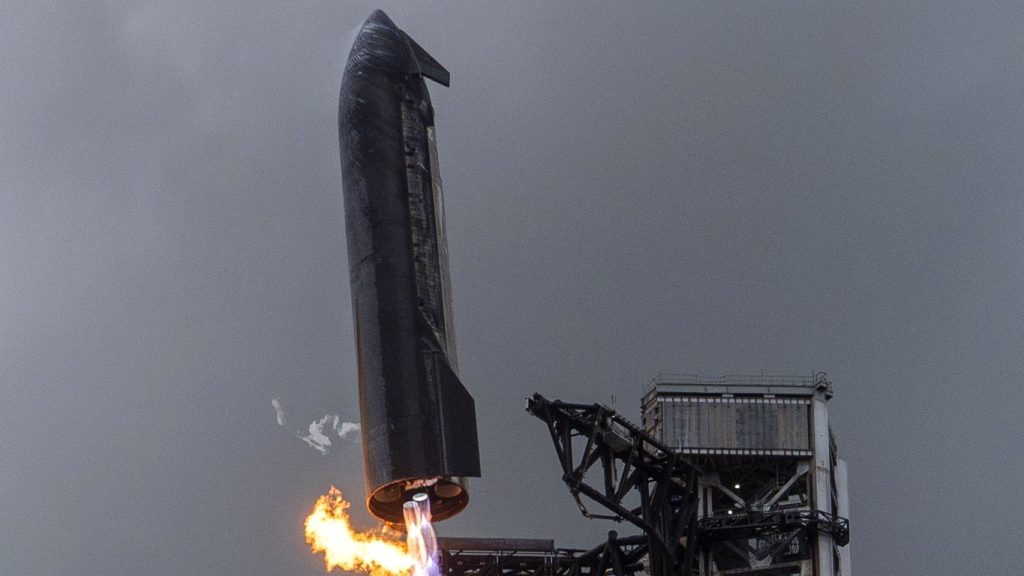
STARBASE, United States: SpaceX caught the upper stage of its Starship rocket in the mechanical arms of its Texas launch tower on 14 November, the first time the company has recovered that part of the vehicle after a flight into orbit.

Source: Spaceflight Now, Reuters via Business Day, and Associated Press. Data as of 14 November 2026.
The catch, confirmed by Associated Press, Bloomberg and a Reuters report carried by Business Day, is a milestone in the effort to make the entire launch system reusable.
It matters for African connectivity and space-based services because Starship is the vehicle SpaceX intends to use to loft more Starlink satellites at lower cost. That promise is still a test result, not a change in today’s prices.
The uncrewed upper stage, known as Ship 42, came down at Starbase, Texas, on Saturday afternoon, about 22 hours after Friday’s launch. Reuters, in a report published by Business Day, said the 52-metre vehicle came out of thick cloud, flipped upright and descended into the tower’s “Mechazilla” arms with its engines still firing, then hung still after the system’s longest mission yet.
AP said the ship was caught “in midair by giant mechanical arms where its journey began 22 hours earlier”, and that it was “the first-ever capture of a Starship flying back from space.”
Views from Mechazilla of the first ever Starship catch
— SpaceX (@SpaceX) November 16, 2026
The integrated vehicle lifted off from Starbase at 4:47 p.m. Central Time on Friday, 13 November, according to Spaceflight Now.
The news site timed the Saturday catch at 3:20 p.m. Central Time (21:20 UTC).
After reaching orbit, the ship deployed 26 Starlink satellites and completed 14 orbits, Reuters and Spaceflight Now reported.
Reuters said the orbital portion of the flight lasted 22.5 hours and that the ship was flying at about 260 kilometres in altitude when the satellites were released.
The company had hoped to catch both stages on Flight 15, which would have been a first for a full orbital launch system. That did not happen.
The Super Heavy booster, Booster 22, was diverted away from the tower after liftoff and exploded over the Gulf of Mexico. CNBC, citing the flight, said it exploded before hitting the water.
Reuters said the failed booster return “nix[ed] SpaceX’s plan to recover both parts of the rocket for the first time.”
AP and Reuters reported that SpaceX’s Kate Tice said the booster’s engines stopped firing too soon on the way back down. Its guidance system then sensed it was not in the right position and automatically sent it to a watery detour and self-destruction.
Engineers were still investigating the cause.
An NBC News report described the booster as “low on fuel”; that wording was not used in the AP or Reuters accounts, and is not treated here as an established fact.
SpaceX had already caught boosters on three earlier flights, AP and Reuters noted. Version 3 of Super Heavy had not yet made a successful return.
On the company’s webcast, mission commentator Dan Huot said of the ship catch, in wording from the Reuters report published by Business Day:
That was the missing link, the holy grail of spaceflight.
AFP, quoted by the BBC, gave a longer version:
That was the Holy Grail of space flight, plummeting through fire to be snatched out of the air by steel. We caught a Starship and now everything changes.
Spaceflight Now quoted company founder Elon Musk as writing:
The epic day has arrived, thanks to the incredibly talented team at SpaceX.
Reuters reported that Musk later wrote on X, after inspecting the vehicle:
Ship 42 looks great!
The catch does not by itself make Starship fully reusable.
Reuters noted that SpaceX has still not recovered both stages on a single mission, and that the heat shield, made of hexagonal tiles, is not yet fully reusable without refurbishment.
Starship is not a Botswana story on the day of the flight. It is a test of whether the world’s most ambitious launch system can bring its upper stage home, which is the step that would allow faster reuse and heavier, cheaper satellite loads.
Reuters said Musk sees Starship as the future workhorse for SpaceX’s Starlink business, as well as for orbital data centres, NASA moon landings and, eventually, Mars.
African governments and firms already live with the practical side of that system. South African President Cyril Ramaphosa said this week that Starlink must follow South Africa’s licensing and ownership rules.
A fully reusable heavy launcher, if it is later flown often and cheaply, could change the cost of broadband, Earth observation and mining-related data services that Botswana and its neighbours buy.
That is a prospect to watch, not a price cut that has already arrived.
Brimco earlier reported Starship’s first reach of orbit in September. Saturday’s catch is the next measured step, with the booster failure still on the ledger.
People in this story: Elon Musk

Written by
Tumisang Bogwasi, Founder & CEO of Brimco. 2X Award-Winning Entrepreneur. It all started with a popsicle stand.