The James Webb Space Telescope (JWST) has provided unprecedented observations of exoplanet WASP-18 b, a gas giant orbiting its star closely. These findings, published by NASA, indicate the presence of water vapor despite extreme temperatures, offering crucial insights into planetary atmospheric composition and evolution. This discovery underscores the advanced capabilities of the JWST in furthering exoplanetary science and its potential implications for future space technology and research investments.
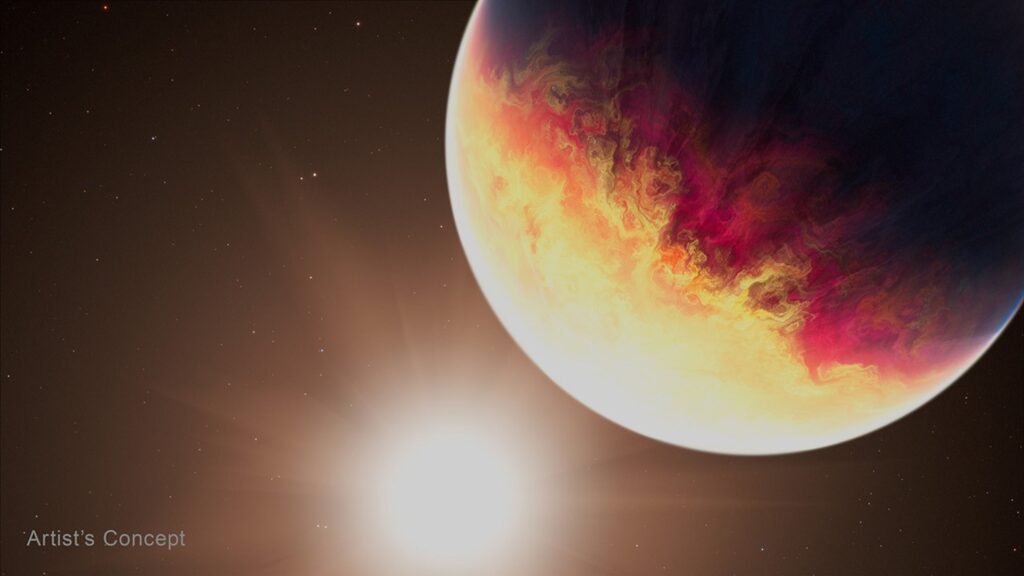
Washington D.C., United States – The James Webb Space Telescope (JWST) has delivered groundbreaking insights into the atmospheric conditions of the ultra-hot exoplanet WASP-18 b, detecting water vapor in its scorching environment. This discovery, announced by NASA, marks a significant advance in the characterization of exoplanetary atmospheres, pushing the boundaries of what scientists can learn about planets beyond our solar system.
The observations confirm the exoplanet, roughly 10 times the mass of Jupiter, experiences extreme temperatures due to its tight orbital proximity to its host star, completing an orbit in less than 23 hours, as detailed in a NASA science release.

The detection of water vapor in WASP-18 b’s atmosphere is particularly notable given the exoplanet’s extreme conditions. The gas giant, tidally locked and constantly bombarded by radiation, reaches temperatures around 2,700 degrees Celsius (4,900 degrees Fahrenheit). Despite these conditions, Webb’s sensitive instruments were able to identify the signature of water, providing critical data for understanding how planetary atmospheres form and evolve under intense stellar influence, according to research published in Nature Astronomy.
The James Webb Space Telescope utilizes its infrared capabilities to observe light that has passed through an exoplanet’s atmosphere. Different chemical compounds absorb specific wavelengths of light, allowing scientists to piece together the atmospheric composition. This method provides an unparalleled view of distant worlds, surpassing the capabilities of previous space telescopes.
The JWST, a collaborative effort between NASA, the European Space Agency (ESA), and the Canadian Space Agency (CSA), represents a monumental investment in space infrastructure. Its primary mirror, nearly 6.5 meters in diameter, allows for unprecedented sensitivity and resolution in the infrared spectrum. This enables observations of faint, distant objects and the detailed analysis of exoplanet atmospheres that were previously impossible.
Since its launch, the Webb telescope has consistently delivered groundbreaking discoveries, from capturing the earliest galaxies to detailed observations within our own solar system. Its ability to penetrate cosmic dust and gas clouds makes it an indispensable tool for astronomers studying the origins of the universe and the potential for life beyond Earth.
The success of missions like the James Webb Space Telescope carries significant implications for the global aerospace industry and associated economic sectors. Government funding for ambitious space projects, primarily through agencies like NASA, fuels innovation and drives demand for advanced materials, precision engineering, and computational technologies across the United States and its international partners.
Furthermore, the data generated by the JWST not only advances fundamental scientific understanding but also creates new opportunities for commercial applications. The development of sophisticated sensors, imaging techniques, and data processing algorithms for space telescopes can lead to spin-off technologies applicable in fields such as remote sensing, environmental monitoring, and medical diagnostics. This continuous cycle of research and development supports high-tech employment and economic growth in regions with strong aerospace and tech industries.
Continued international collaboration on space missions like Webb underscores the strategic importance of scientific partnerships. These projects foster knowledge exchange, strengthen diplomatic ties, and pool resources for endeavors that would be unattainable for a single nation, thereby boosting the collective scientific and technological prowess of participating economies.

Written by
Tumisang Bogwasi, Founder & CEO of Brimco. 2X Award-Winning Entrepreneur. It all started with a popsicle stand.