President Duma Boko told TRT World at COP31 that Botswana does not depend on China or the United States and picks its mining partners. His claims that diamonds are rebounding and that a mine is upgrading a technical college are supported only in part by published records.
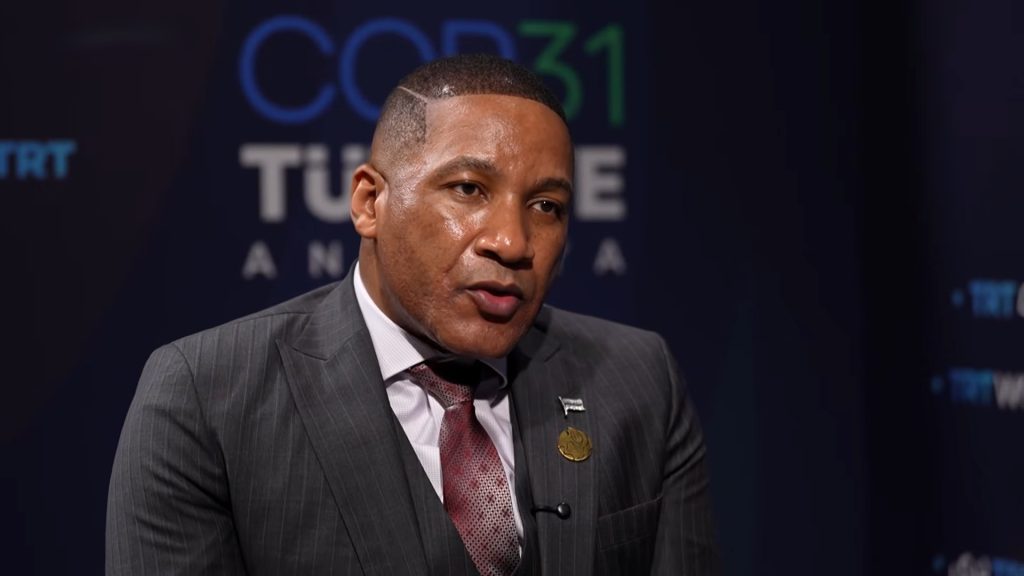
ANTALYA, Türkiye: President Duma Boko told TRT World at COP31 that “we hold the trump card” in Botswana’s dealings with the buyers of its minerals, saying the country depends on neither China nor the United States. In the interview with Ghida Fakhry, released on 20 November, he also said diamonds are rebounding and that a mining company is helping to upgrade a technical college. Published records support the first claim only in part and do not describe the second as he put it.

Mining value added covers all mining, not only diamonds. The 2024 comparison is on our calculation from Statistics Botswana’s year-on-year changes. Sources: Statistics Botswana GDP release for the second quarter of 2026 and its 2024/25 household survey labour brief; Business Weekly.
Fakhry put it to him that Botswana is never an equal partner while it relies on foreign firms for technology, capital and markets. Boko answered that Botswana is not merely equal: it holds “the trump card”, because it controls its resources and can choose its partners and set the terms.
He said China and the United States are both competing for those resources, that Botswana does not depend on either, and that it deals with them from a position of strength. A state that refuses to let its minerals leave unprocessed, and brings in foreign skills to work on them at home, is asserting its sovereignty, he said.
He described Botswana’s goal as a high-income, industrialised, diversified, technology-driven and private-sector-led economy, and said the country should be near that point within two to three years. He did not say how it would be measured.
Boko said diamonds are on a rebound and are doing exceptionally well despite lab-grown stones, because marketing of natural diamonds has been restored. He said synthetic stones have no resale value.
Statistics Botswana’s quarterly GDP figures show a recovery in mining, but from a very low base. Mining value added was 81.7% higher in the second quarter of 2026 than a year earlier, and 3.4% higher in the first. The second quarter of 2025 had fallen 37.7%. On our calculation, mining value added in the first half of 2026 was about 4% above the first half of 2024, so the sector is back to roughly its 2024 level, not past it.
The path has also been uneven. Mining value added was P10.8 billion in the third quarter of 2025 and P4.3 billion in the fourth. The figures cover all mining, not only diamonds.
Other signs are mixed. Okavango Diamond Company’s chairman said on 16 November that it had returned to profit, with sales of $645.2 million this year, a company statement that Brimco could not match to a filing (Brimco report). The government’s own mid-year review put diamonds at 24% of revenue, down from 35% (Brimco report), and the economist Keith Jefferis told Brimco the downturn is structural, not cyclical.
Asked about unemployed young people, Boko said the real problem is a mismatch between skills and the jobs available, not a total absence of jobs. He said MMG’s Khoemacau mine has put resources into upgrading a technical college to produce job-ready artisans, and that government is using vocational college trainees, and out-of-school youth as apprentices, to refurbish schools and other government buildings.
MMG Khoemacau and the Ministry of Higher Education signed a memorandum of understanding on 24 July 2026 to set up a Centre of Mining Excellence hosted at Maun Technical College, with initial seed funding from the mine, according to MMG’s release. The release gives no amount and does not describe an upgrade of the college. Business Weekly reported on 3 September that a follow-up memorandum of agreement had been signed, that early works are expected by the end of the year and that the first cohort is targeted for April 2027.
The latest household survey puts unemployment at 21.0%, or 213,437 people, in preliminary results for 2024/25. It does not say how many of them lack the skills the mines want.
On climate finance he repeated his call for grants and low-interest loans over long periods, and said the pledges made so far have not been met. Botswana does not yet have the funding and technology to move from coal to solar, he said, though it is beginning to receive some. Brimco reported his COP31 summit speech on 11 November.
On De Beers, he repeated that Botswana will raise its stake from 15% to 30%, naming Angola, Namibia and Oman as other parties alongside the private sector. He said the structure of the deal means Botswana’s existing cutting and polishing firms will receive more rough stock, and that Botswana will have a stake and some influence in jewellery manufacturing. He gave no detail, and Brimco has not found those terms in any published report. Brimco reported on 17 November that the agreements are still to be negotiated.
Mining contractors, suppliers and lenders are planning around whether output returns to its old level. The data so far shows a recovery to roughly 2024 levels, with large swings from one quarter to the next. For employers who say they cannot find skilled artisans, the Maun centre will not have a first cohort until April 2027.
Statistics Botswana’s third-quarter GDP release will show whether mining output holds up. Botswana plans to launch its first national ESG strategy in December 2026, Boko said at COP31. Early works at the Maun centre are expected by the end of the year. The terms of the De Beers deal have yet to be published.
People in this story: Duma Gideon Boko

Written by
Tumisang Bogwasi, Founder & CEO of Brimco. 2X Award-Winning Entrepreneur. It all started with a popsicle stand.