NASA's newly published research on Martian ultraviolet auroras and solar wind interactions offers critical data for commercial and defense aerospace contractors to manage orbital decay and radiation shielding risks.
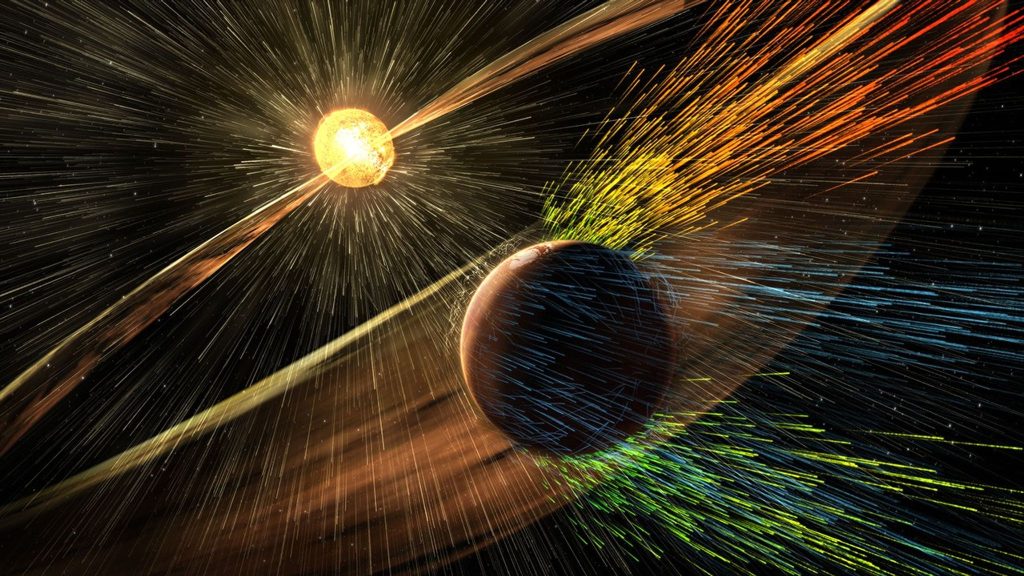
WASHINGTON, United States – NASA spacecraft mapped the physical mechanisms behind Martian auroras on Wednesday, according to research published by the National Aeronautics and Space Administration. The findings detail how high-energy particles from solar storms interact with the unmagnetized upper atmosphere of Mars, creating widespread ultraviolet light displays that differ from Earth’s polar lights.

The study provides crucial atmospheric modeling data for aerospace firms planning deep-space missions and orbital satellite deployments. Understanding these planetary weather patterns allows operators to mitigate radiation risks and optimize spacecraft trajectories.
Federal research allocations for deep space exploration[](https://www.brimco.io/news/nasa-spotlights-waxing-gibbous-moon-amidst-renewed-lunar-exploration-drive/) remain tied to space weather phenomena that threaten commercial and defense orbital infrastructure. U.S. government agencies and commercial partners like SpaceX must account for atmospheric variability when calculating fuel budgets and trajectory maneuvers for spacecraft. This atmospheric modeling directly impacts the valuation of satellite constellations and long-term asset security in high-radiation environments.
Furthermore, shifting federal priorities regarding interplanetary transit drive increased capital deployment toward radiation mitigation technologies. Defense and aerospace manufacturers securing government contracts must integrate these insights into their next-generation spacecraft designs. This alignment between scientific discovery and commercial engineering helps ensure that public and private infrastructure investments withstand extreme solar events.
Unlike Earth, which relies on an internal magnetic field to deflect charged particles, Mars lost its global magnetic shield billions of years ago. Consequently, solar wind protons and electrons strike the Martian atmosphere directly across the entire planetary disk. As these energetic particles collide with carbon dioxide and other atmospheric molecules, they trigger discrete ultraviolet emissions that cover the globe.
Aerospace engineers analyze these atmospheric interactions to refine predictive models for orbital decay. Increased solar activity heats the upper thermosphere of Mars, expanding the atmosphere and increasing drag on spacecraft such as the Mars Reconnaissance Orbiter. Accurately forecasting these density fluctuations prevents unexpected orbital degradation and safeguards scientific assets operating in Martian orbit.
As private aerospace firms and public space agencies accelerate timelines for robotic and human missions, understanding planetary weather patterns becomes an economic imperative. Comprehensive data on solar wind dynamics allows mission planners to optimize communication relay orbits and protect sensitive electronics from cumulative radiation damage.
These technical breakthroughs establish baseline operating standards for future commercial ventures utilizing advanced robotic systems throughout the inner solar system. By reducing the risks associated with unpredictable space weather, operators can attract more private capital to deep-space logistics and communication networks.
Watch: Perseverance Captures Mysterious Green Auroras on Mars 🌌

Written by
Tumisang Bogwasi, Founder & CEO of Brimco. 2X Award-Winning Entrepreneur. It all started with a popsicle stand.